O Brother Where Art Thou Girls Audition on No What We Gonna Do
| O Brother, Where Art Thou? | |
|---|---|
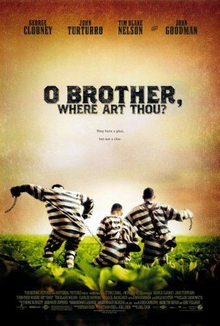 Theatrical release poster | |
| Directed past | Joel Coen |
| Written by |
|
| Based on | The Odyssey past Homer |
| Produced by | Ethan Coen |
| Starring |
|
| Cinematography | Roger Deakins |
| Edited by |
|
| Music by | T Os Burnett |
| Production |
|
| Distributed past |
|
| Release dates |
|
| Running fourth dimension | 107 minutes |
| Countries |
|
| Linguistic communication | English language |
| Budget | $26 meg[9] |
| Box function | $72 million[7] |
O Brother, Where Art Thou? is a 2000 criminal offense one-act drama musical film written, produced, co-edited and directed by Joel and Ethan Coen and starring George Clooney, John Turturro, and Tim Blake Nelson, with Chris Thomas Rex, John Goodman, Holly Hunter, and Charles Durning in supporting roles.
The motion-picture show is set in 1937 rural Mississippi during the Nifty Depression. Its story is a modern satire loosely based on Homer's epic Greek verse form The Odyssey that incorporates social features of the American South.[10] The title of the film is a reference to the Preston Sturges 1941 film Sullivan's Travels, in which the protagonist is a director who wants to film O Blood brother, Where Art Thou?, a fictitious book nigh the Great Depression.[11]
Much of the music used in the film is period folk music.[12] The picture was one of the offset to extensively utilize digital color correction to give the picture an autumnal, sepia-tinted expect.[13] Released by Buena Vista Pictures (through Touchstone Pictures) in N America, France, Deutschland, Italia, and Spain and by Universal Pictures in other countries, the film was met with a positive critical reception, and the soundtrack won a Grammy Honor for Album of the Year in 2002, making it the only motion picture soundtrack to take ever received the honour.[14] The state and folk musicians who were dubbed into the film include John Hartford, Alison Krauss, Dan Tyminski, Emmylou Harris, Gillian Welch, Ralph Stanley, Chris Sharp, Patty Loveless, and others. They joined to perform the music from the film in the Down from the Mount concert tour, which was filmed for consumer consumption via Idiot box and DVD.[12] [15]
Plot [edit]
Three convicts, Pete and Delmar led past Ulysses Everett McGill, escape from a concatenation gang and gear up out to recollect a treasure Everett said was buried before the area is flooded to brand a lake. The three get a lift from a blind man driving a handcar on a railway. He tells them they will find a fortune, simply not the one they seek. The trio make their way to the house of Wash, Pete's cousin. They slumber in the barn, but Wash reports them to Sheriff Cooley, who, along with his men, torches the barn. Launder's son helps them escape.
They pick up Tommy Johnson, a young black human, who claims he sold his soul to the devil in substitution for the ability to play guitar. In need of money, the 4 stop at a radio station where they record a song equally the Soggy Bottom Boys. That night, the trio function ways with Tommy subsequently their car is discovered by the police. Unbeknownst to them, their recording becomes a major striking. They briefly fall in with Babe Face Nelson and accompany him on a robbery.
Nearly a river, the group hears singing. They come across three women washing clothes and singing. The women drug them with corn whiskey and they lose consciousness. Upon waking, Delmar finds Pete'south clothes lying next to him, empty except for a toad. Delmar is convinced the women were sirens and transformed Pete into the toad. Later, one-eyed Bible salesman Big Dan invites them for a picnic lunch, then mugs them, takes all their money, and kills the toad.
On their way to Everett'south dwelling house town, Everett and Delmar see Pete working on a chain gang. Upon arriving Everett confronts his wife Penny, who changed her last name and told their daughters he was dead. He gets into a fight with Vernon, whom she is to marry the next day. Later that night, they sneak into Pete'southward belongings prison cell and free him. As information technology turns out, the women had dragged Pete away and turned him in to the authorities. Under torture, Pete gave away the treasure'south location to the police. Everett and then confesses that at that place is no treasure. He fabricated it up to convince Pete and Delmar, who were chained to him, to escape with him in order to stop his wife from getting married. He reveals that he got arrested for practicing law without a license. Pete is enraged at Everett, because he had two weeks left on his original sentence, and must serve fifty more years for the escape.
The trio stumble upon a rally of the Ku Klux Klan, who are planning to hang Tommy. The trio disguise themselves as Klansmen and attempt to rescue Tommy. Withal, Large Dan, a Klan member, reveals their identities. Anarchy ensues, and the Grand Sorcerer reveals himself as Homer Stokes, a candidate in the upcoming gubernatorial ballot. The trio rush Tommy away and cutting the supports of a large burning cantankerous, leaving it to fall on Large Dan.
Everett convinces Pete, Delmar and Tommy to help him win his wife back. They sneak into a Stokes campaign gala dinner she is attending, disguised every bit musicians. The group begins a performance of their radio hit. The crowd recognizes the song and goes wild. Homer recognizes them equally the group who humiliated his mob. When he demands the group be arrested and reveals his white supremacist views, the crowd runs him out of town on a track. Pappy O'Daniel, the incumbent candidate, seizes the opportunity, endorses the Soggy Bottom Boys and grants them total pardons. Penny agrees to ally Everett with the condition that he find her original ring.
The next morning time, the group sets out to remember the ring, which is inside a motel in the valley which Everett had earlier claimed was the location of his treasure. The police force, having learned of the place from Pete, arrest the group. Dismissing their claims of having received pardons, Sheriff Cooley orders them hanged. But equally Everett prays to God, the valley is flooded and they are saved. Tommy finds the band in a desk-bound that floats by, and they return to boondocks. Even so, when Everett presents the ring to Penny, information technology turns out it was her aunt'southward band. She declares that she volition non ally him with that ring, only only her wedding ring which she cannot call up where she put.
Cast [edit]
- George Clooney as Ulysses Everett McGill. He corresponds to Odysseus (Ulysses) in the Odyssey.[16] His singing voice is dubbed by Dan Tyminski.
- John Turturro as Pete. (His terminal name is never stated in the film) Along with Delmar, Pete represents Odysseus' soldiers who wander with him from Troy to Ithaca, seeking to return home. His singing is dubbed past Harley Allen.
- Tim Blake Nelson every bit Delmar O'Donnell. Nelson does his ain singing on "In the Jailhouse Now", but is otherwise dubbed past Pat Enright.
- Chris Thomas King as Tommy Johnson, a skilled blues musician. He shares his name and story with Tommy Johnson, a blues musician who is said to have sold his soul to the devil at the Crossroads (as well attributed to Robert Johnson).[17] [18]
- John Goodman as Daniel "Big Dan" Teague, a ane-eyed mugger and Ku Klux Klan fellow member who masquerades every bit a Bible salesman. He corresponds to the cyclops Polyphemus in the Odyssey.[sixteen]
- Holly Hunter equally Penny Wharvey-McGill, Everett'due south ex-married woman. She corresponds to Penelope in the Odyssey.[xvi]
- Charles Durning as Menelaus "Pappy" O'Daniel, the governor of Mississippi. The character is based on Texas governor W. Lee "Pappy" O'Daniel.[19] He shares a name with Menelaus, an Odyssey character, but corresponds with Zeus from the narrative.[sixteen]
- Daniel von Bargen as Sheriff Cooley, a ruthless rural sheriff who pursues the trio for the duration of the film. He corresponds to Poseidon in the Odyssey.[16] He has been compared to Boss Godfrey in Cool Mitt Luke.[20]
- Wayne Duvall equally Homer Stokes, a candidate for governor and the leader of a Ku Klux Klan mob. His singing is dubbed past Ralph Stanley.
- Ray McKinnon as Vernon T. Waldrip. He corresponds to the Suitors of Penelope in the Odyssey.[16]
- Frank Collison as Washington Bartholomew "Wash" Hogwallop, Pete'south cousin.
- Michael Badalucco as Baby Face Nelson.
- Stephen Root as Mr. Lund, a blind radio station manager. He corresponds to Homer.[xvi]
- Lee Weaver every bit the Blind Seer, who accurately predicts the outcome of the trio's gamble. He corresponds to Tiresias in the Odyssey.[16]
- Mia Tate, Musetta Vander, and Christy Taylor as the three "sirens". Their singing voices are dubbed by Emmylou Harris, Alison Krauss, and Gillian Welch.
Gillian Welch and Dan Tyminski also appear as a record store customer and a mandolinist, respectively. Del Pentacost, JR Horne, and Brian Reddy appear equally members of Pappy O'Daniel'southward staff. Ed Gale appears equally Homer Stokes' ceremonial "trivial human." Three members of the Fairfield Four (Isaac Freeman, Wilson Waters Jr, and Robert Hamlett) cameo as gravediggers. The Cox Family unit and The Whites announced every bit fictionalized versions of themselves.
Production [edit]
The idea of O Blood brother, Where Art Thou? arose spontaneously. Work on the script began in December 1997, long earlier the beginning of product, and was at to the lowest degree half-written by May 1998. Despite the fact that Ethan Coen described the Odyssey equally "one of my favorite storyline schemes", neither of the brothers had read the ballsy, and they were just familiar with its content through adaptations and numerous references to the Odyssey in popular civilisation.[21] According to the brothers, Tim Blake Nelson (who has a degree in classics from Brown University)[22] [23] was the only person on the set who had read the Odyssey.[24]
The title of the moving-picture show is a reference to the 1941 Preston Sturges moving picture Sullivan's Travels, in which the protagonist (a director) wants to direct a motion picture about the Great Depression called O Brother, Where Art Thou? [11] that volition be a "commentary on modern weather, stark realism, and the problems that confront the average man". Lacking any experience in this area, the director sets out on a journeying to experience the human suffering of the average man simply is sabotaged by his anxious studio. The picture show has some similarity in tone to Sturges'southward film, including scenes with prison gangs and a blackness church choir. The prisoners at the moving-picture show bear witness scene is also a directly homage to a nigh identical scene in Sturges'southward film.[25]
Joel Coen revealed in a 2000 interview that he traveled to Phoenix to offering the lead function to Clooney. Clooney agreed to practise the office immediately, without reading the script. He stated that he liked fifty-fifty the Coens' least successful films.[26] Clooney did non immediately sympathize his character and sent the script to his uncle Jack, who lived in Kentucky, asking him to read the entire script into a tape recorder.[27] Unknown to Clooney, in his recording, Jack, a devout Baptist, omitted all instances of the words "damn" and "hell" from the Coens' script, which only became known to Clooney later on the directors pointed this out to him during shooting.[27]
This was the 4th film of the brothers in which John Turturro has starred. Other actors in O Blood brother, Where Art Thousand? who had worked previously with the Coens include John Goodman (three films), Holly Hunter (two), Charles Durning (2) and Michael Badalucco (one).
The Coens used digital colour correction to give the film a sepia-tinted expect.[thirteen] Joel stated this was because the actual set was "greener than Ireland".[27] Cinematographer Roger Deakins stated, "Ethan and Joel favored a dry, dusty Delta look with golden sunsets. They wanted it to look similar an one-time hand-tinted pic, with the intensity of colors dictated by the scene and natural skin tones that were all shades of the rainbow."[28] Initially the crew tried to perform the color correction using a physical process, however after several tries with various chemic processes proved unsatisfactory, it became necessary to perform the process digitally.[27]
This was the fifth film collaboration between the Coen Brothers and Deakins, and information technology was slated to be shot in Mississippi at a time of year when the foliage, grass, copse, and bushes would be a lush green.[28] It was filmed virtually locations in Canton, Mississippi, and Florence, South Carolina, in the summertime of 1999.[29] After shooting tests, including film bipack and bleach featherbed techniques, Deakins suggested digital mastering be used.[28] Deakins spent 11 weeks fine-tuning the look, mainly targeting the greens, making them a burnt yellow and desaturating the overall image in the digital files.[13] This made it the first feature picture to exist entirely color corrected by digital means, narrowly chirapsia Nick Park'southward Chicken Run.[xiii]
O Brother, Where Art Thou? was the showtime fourth dimension a digital intermediate was used on the entirety of a showtime-run Hollywood film that otherwise had very few visual furnishings. The work was done in Los Angeles by Cinesite using a Spirit DataCine for scanning at 2K resolution, a Pandora MegaDef to adapt the color, and a Kodak Lightning Ii recorder to put out to film.[30]
A major theme of the film is the connexion between old-fourth dimension music and political campaigning in the Southern U.South. It makes reference to the traditions, institutions, and entrada practices of bossism and political reform that divers Southern politics in the starting time one-half of the 20th century.
The Ku Klux Klan, at the fourth dimension a political force of white populism, is depicted burning crosses and engaging in formalism dance. The character Menelaus "Pappy" O'Daniel, the governor of Mississippi and host of the radio show The Flour Hr, is like in name and demeanor to Due west. Lee "Pappy" O'Daniel,[31] ane-fourth dimension Governor of Texas and later U.S. Senator from that land.[32] O'Daniel was in the flour business, and used a backing band called the Light Crust Doughboys on his radio prove.[33] In one entrada, O'Daniel carried a broom, an oft-used campaign device in the reform era, promising to sweep abroad patronage and corruption.[34] His theme song had the hook, "Please pass the biscuits, Pappy", emphasizing his connection with flour.[33]
While the film borrows from historical politics, differences are obvious between the characters in the film and historical political figures. The O'Daniel of the picture show used "You Are My Sunshine" as his theme song (which was originally recorded by singer and Governor of Louisiana James Houston "Jimmie" Davis[35]), and Homer Stokes, as the challenger to the incumbent O'Daniel, portrays himself every bit the "reform candidate", using a broom equally a prop.
Music [edit]
Music was originally conceived as a major component of the moving-picture show, non merely every bit a background or a support. Producer and musician T Bone Burnett worked with the Coens while the script was nevertheless in its working phases and the soundtrack was recorded before filming commenced.[36]
Much of the music used in the motion-picture show is menstruation-specific folk music.[12] The musical pick also includes religious music, including Primitive Baptist and traditional African American gospel, most notably the Fairfield Four, an a cappella quartet with a career extending back to 1921 who appear in the soundtrack and equally gravediggers towards the movie'southward end. Selected songs in the film reflect the possible spectrum of musical styles typical of the onetime civilisation of the American S: gospel, delta blues, state, swing and bluegrass.[24] [37]
The use of dirges and other macabre songs is a theme that oft recurs in Appalachian music[38] ("O Death", "Lonesome Valley", "Angel Band", "I Am Weary") in contrast to brilliant, cheerful songs ("Keep On the Sunny Side", "In the Highways") in other parts of the film.
The voices of the Soggy Bottom Boys were provided by Dan Tyminski (lead vocal on "Man of Constant Sorrow"), Nashville songwriter Harley Allen, and the Nashville Bluegrass Ring'southward Pat Enright.[39] The three won a CMA Award for Single of the Twelvemonth[39] and a Grammy Award for Best Country Collaboration with Vocals, both for the song "Man of Constant Sorrow".[14] Tim Blake Nelson sang the lead vocal on "In the Jailhouse Now".[eleven]
"Man of Constant Sorrow" has five variations: two are used in the film, one in the music video, and 2 in the soundtrack anthology. Two of the variations characteristic the verses being sung back-to-dorsum, and the other iii variations feature boosted music betwixt each verse.[40] Though the song received little significant radio airplay, it reached #35 on the U.S. Billboard Hot Country Singles & Tracks chart in 2002.[36] [41] The version of "I'll Fly Away" heard in the film is performed not by Krauss and Welch (every bit information technology is on the CD and concert bout), but by the Kossoy Sisters with Erik Darling accompanying on long-neck five-cord banjo, recorded in 1956 for the album Bowling Green on Tradition Records.[42]
Release [edit]
The film premiered at the AFI Picture Festival on October 19, 2000, and the United States on December 22, 2000.[2] It grossed $71,868,327 worldwide off its $26 one thousand thousand upkeep.[7] [nine]
Critical reception [edit]
Review aggregation website Rotten Tomatoes gives it a score of 78% based on 154 reviews and an average score of 7.12/10. The consensus reads: "Though not as good every bit Coen brothers' classics such as Blood Simple, the delightfully loopy O Brother, Where Art Chiliad? is even so a lot of fun."[43] The motion picture holds an average score of 69/100 on Metacritic based on 30 reviews.[44]
Roger Ebert gave two and a one-half out of four stars to the film, proverb all the scenes in the moving picture were "wonderful in their unlike means, and yet I left the movie uncertain and unsatisfied".[45]
Accolades [edit]
The pic was selected into the chief competition of the 2000 Cannes Motion-picture show Festival.[8]
| Accolade | Date of ceremony | Category | Recipient(s) | Issue | Ref |
|---|---|---|---|---|---|
| Academy Awards | March 25, 2001 | Best Adapted Screenplay | Ethan Coen Joel Coen | Nominated | [46] |
| Best Cinematography | Roger Deakins | Nominated | |||
| BAFTA Awards | Feb 25, 2001 | All-time Screenplay – Original | Ethan Coen Joel Coen | Nominated | |
| Best Cinematography | Roger Deakins | Nominated | |||
| Best Production Design | Dennis Gassner | Nominated | |||
| American Movie house Editors | 2001 | Best Edited Feature Flick – Comedy or Musical | Ethan Coen Tricia Cooke | Nominated | |
| American Comedy Awards | 2001 | Funniest Actor in a Movement Flick (Leading Role) | George Clooney | Nominated | |
| American Club of Cinematographers | 2001 | Outstanding Achievement in Cinematography in Theatrical Releases | Roger Deakins | Nominated | |
| Awards Circuit Community Awards | 2000 | Best Adjusted Screenplay | Ethan Coen Joel Coen | Nominated | |
| Best Cast Ensemble | George Clooney John Turturro Tim Blake Nelson Charles Durning Michael Badalucco John Goodman Holly Hunter | Nominated | |||
| Best Art Management | Dennis Gassner | Nominated | |||
| Best Cinematography | Roger Deakins | Nominated | |||
| Best Costume Design | Mary Zophres | Nominated | |||
| BMI Moving picture & TV Awards | 2002 | Special Citation | T Os Burnett | Won | |
| British Guild of Cinematographers | 2001 | Best Cinematography | Roger Deakins | Won | |
| Cannes Film Festival | 2000 | Palme d'Or | Joel Coen | Nominated | |
| Chicago Film Critics Association Awards | 2001 | Best Cinematography | Roger Deakins | Nominated | |
| Best Original Score | Carter Burwell T Os Burnett | Nominated | |||
| Dallas-Fort Worth Motion picture Critics Association Awards | 2001 | Best Motion picture | O Brother Where Art G? | Nominated | |
| Best Manager | Joel Coen | Nominated | |||
| Empire Awards | 2001 | Best Actor | George Clooney | Nominated | |
| European Film Awards | 2000 | Screen International Honour (USA) | Joel Coen | Nominated | |
| Faro Island Pic Festival | 2000 | Best Film | Ethan Coen Joel Coen | Nominated | |
| Florida Film Critics Circle Awards | 2001 | Best Soundtrack and Score | Carter Burwell T Bone Burnett | Won | |
| Gilt Globes | January 21, 2001 | Best Film – Comedy or Musical | O Blood brother Where Fine art Grand? | Nominated | [47] |
| All-time Performance by an Thespian in a Movement Picture – Comedy or Musical | George Clooney | Won | |||
| Grammy Awards | February 27, 2002 | Album of the Year | Alison Krauss Wedlock Station Tim Blake Nelson Chris Thomas Male monarch Emmylou Harris Gillian Welch Harley Allen John Hartford Norman Blake Pat Enright Hannah Peasall Leah Peasall Sarah Peasall Ralph Stanley Sam Bush Stuart Duncan The Cox Family The Fairfield Four The Whites T Bone Burnett Peter 1000. Kurland Mike Piersante Gavin Lurssen Jerry Douglas Barry Bales Ron Block Dan Tyminski Cheryl White Sharon White | Won | [48] |
| All-time Compilation Soundtrack Album for a Motion Motion-picture show, Television receiver or Other Visual Media | T Bone Burnett Mike Piersante Peter F. Kurland | Won | |||
| Las Vegas Film Critics Order Awards | 2000 | Best Cinematography | Roger Deakins | Won | |
| Best Screenplay, Original | Ethan Coen Joel Coen | Nominated | |||
| Best Costume Design | Mary Zophres | Nominated | |||
| London Critics Circumvolve Film Awards | 2001 | Motion-picture show of the Year | O Brother Where Art Grand? | Nominated | |
| Screenwriter of the Year | Ethan Coen Joel Coen | Nominated | |||
| MTV Movie + Idiot box Awards | June two, 2001 | All-time On-Screen Team (The Soggy Bottom Boys) | George Clooney Tim Blake Nelson John Turturro | Nominated | |
| Best Music Moment | "Human being Of Constant Sorrow" | Nominated | |||
| Online Film Critics Society Awards | Jan 2, 2001 | Best Original Score | T Bone Burnett Carter Burwell | Nominated | |
| Best Cinematography | Roger Deakins | Nominated | |||
| Phoenix Film Critics Society Awards | 2001 | Best Original Score | T Bone Burnett Carter Burwell | Nominated | |
| Satellite Awards | January 14, 2001 | Best Movement Pic, Comedy or Musical | O Brother Where Art Thou? | Nominated | |
| Best Screenplay, Adapted | Ethan Coen Joel Coen | Nominated | |||
| Best Role player in a Motion Motion picture, Comedy or Musical | George Clooney | Nominated | |||
| Best Actor in a Supporting Role, Comedy or Musical | Tim Blake Nelson | Nominated | |||
| Best Actress in a Supporting Office, Comedy or Musical | Holly Hunter | Nominated | |||
| Scientific discipline Fiction Fantasy Writers of America | 2002 | Best Script | Ethan Coen Joel Coen | Nominated | |
| Turkish Film Critics Association Awards | 2001 | Best Strange Motion picture | O Blood brother Where Art Thou? | Nominated |
Soggy Bottom Boys [edit]
The Soggy Bottom Boys are the fictional musical group that the main characters course to serve as accessory for the film. It has been suggested that the proper noun is in homage to the Foggy Mount Boys, a bluegrass band led by Lester Flatt and Earl Scruggs.[49] In the motion picture, the songs credited to the band are lip-synched by the actors, except that Tim Blake Nelson does sing his own vocals on "In the Jailhouse Now".
The band's hitting single is Dick Burnett'southward "Man of Constant Sorrow", a song that had enjoyed much success prior to the motion-picture show's release.[50] After the motion picture's release, the fictitious ring became and so popular that the country and folk musicians who were dubbed into the film got together and performed the music from the motion picture in a Down from the Mount concert tour, which was filmed for Tv and DVD.[12] This included Ralph Stanley, John Hartford, Alison Krauss, Emmylou Harris, Gillian Welch, Chris Precipitous, Stun Seymour, Dan Tyminski and others.
Notes [edit]
- ^ Co-distributed with Universal Pictures in Deutschland and Italian republic[4] and Warner Sogefilms in Spain.[iv]
- ^ Co-distributed with Universal Pictures.[4]
- ^ Co-distributed with Buena Vista Pictures Distribution.[7]
References [edit]
- ^ a b c "O Brother, Where Art Thou? (2000)". world wide web.the-numbers.com. The Numbers. Retrieved October xix, 2018.
- ^ a b c d e f "O Brother, Where Art Thousand?". American Pic Constitute. Archived from the original on December 20, 2014. Retrieved January 24, 2018.
- ^ "O Brother, Where Art Thou? (2000)". British Moving picture Institute. www.bfi.org. Retrieved October 17, 2018.
- ^ a b c d "Film #15267: O Brother, Where Art K?". Lumiere . Retrieved May 29, 2021.
- ^ Minns, Adam (May 10, 2000). "Momentum confirms Brother, Rocky acquisitions". Screen International . Retrieved Oct 8, 2021.
- ^ "O Brother, Where Art G?". BBFC . Retrieved May 29, 2021.
- ^ a b c "O Brother, Where Fine art Thou? (2000)". Box Office Mojo . Retrieved January 8, 2008.
- ^ a b "O Brother, Where Fine art Thou?". Festival de Cannes . Retrieved October 10, 2009.
- ^ a b "Box Office Data:O Brother Where Fine art Thou". The Numbers.com.
- ^ Gray, Richard J.; Robinson, Owen (April 15, 2008). A companion to the literature and civilization of the American south . John Wiley & Sons. ISBN978-0470756690.
- ^ a b c Lafrance, J.D. (April 5, 2004). "The Coen Brothers FAQ" (PDF). pp. 33–35. Archived from the original (PDF) on Nov 26, 2007. Retrieved November 8, 2007.
- ^ a b c d Menaker, Daniel (November 30, 2000). "A Film Score Odyssey Downwards a Quirky Country Road". The New York Times . Retrieved February 4, 2010.
- ^ a b c d Robertson, Barbara (May one, 2006). "CGSociety — The Colorists". The Colorists: 3. Archived from the original on January 22, 2012. Retrieved October 24, 2007. Filmed near locations in Canton, Mississippi; Vicksburg, Mississippi and Wardville, Louisiana.
- ^ a b "The 2002 Grammy Winners". San Francisco Relate. February 28, 2002. Retrieved September 9, 2018.
- ^ "Pioneering Bluegrass Musician Ralph Stanley". Fresh Air. Dec 27, 1992. NPR. Retrieved September nine, 2018.
- ^ a b c d eastward f thousand h Flensted-Jensen, Pernille (2002), "Something sometime, something new, something borrowed: the Odyssey and O Blood brother, Where Art Thou", Classica Et Mediaevalia: Revue Danoise De Philologie, 53: thirteen–30, ISBN978-8772898537
- ^ "The real king of delta blues - Tommy Johnson". Erinharpe.com . Retrieved Baronial 24, 2016.
- ^ "Dejection Singers". University of Virginia. Retrieved August 24, 2016.
- ^ Sorin, Hillary (August 4, 2010), "Today in Texas History: Gov. Pappy O'Daniel resigns", The Houston Relate , retrieved Baronial 2, 2011,
Many cultural and political historians call back the graphic symbol Gov. Menelaus "Pappy" O'Daniel of Mississippi is based on the notorious Texas political leader, Wilbert Lee "Pappy" O'Daniel.
- ^ Conard, Mark T. (March 1, 2009). The Philosophy of the Coen Brothers. University of Kentycky Press. p. 58. ISBN978-0813138695.
- ^ Ciment, Michel; Niogret, Hubert (1998). The Logic of Soft Drugs . Positif. Positive. ISBN9781578068890.
- ^ Tim Blake Nelson Biography Yahoo! MoviesArchived June 28, 2011, at the Wayback Machine
- ^ Molvar, Kari (March–April 2001). "Q&A: Tim Blake Nelson". Brown Alumni Magazine. Archived from the original on Dec 26, 2001. Retrieved December 26, 2001.
- ^ a b Romney, Jonathan (May nineteen, 2000). "Double Vision". The Guardian. London. Retrieved September 9, 2018.
- ^ Dirks, Tim. "Sullivan's Travels (1941)". AMC Filmsite . Retrieved November viii, 2007.
- ^ Hochman, Steve (December 22, 2000). "George Clooney: O Brother, Where Fine art Thou?". Los Angeles Times . Retrieved October 8, 2013.
- ^ a b c d Sharf, Zach (September xxx, 2015). "The Coen Brothers and George Clooney Uncover the Magic of 'O Brother, Where Art Thou?' at 15th Anniversary Reunion". IndieWire . Retrieved November 19, 2015.
- ^ a b c Allen, Robert. "Digital Domain". The Digital Domain: A brief history of digital picture show mastering — a glance at the time to come. Archived from the original on February 4, 2012. Retrieved May 14, 2007.
- ^ "O Blood brother, Where Art Thou: Box office / business". IMDb. Archived from the original on October vii, 2010. Retrieved Feb thirteen, 2012.
- ^ Fisher, Bob (October 2000). "Escaping from chains". American Cinematographer.
- ^ Crawford, Bill (October 11, 2013). Please Pass the Biscuits, Pappy: Pictures of Governor W. Lee "Pappy" O'Daniel. University of Texas Press. p. nineteen. ISBN978-0292757813.
- ^ "Pappy O'Daniel". Texas Treasures. Texas State Library. March 11, 2003. Retrieved November 2, 2007.
- ^ a b Walker, Jesse (Baronial 19, 2003). "Pass the Biscuits – We're living in Pappy O'Daniel'southward world". Reason . Retrieved November 2, 2007.
- ^ Boulard, Garry (Feb iv, 2002). "Following the Leaders". Gambit. p. ane. Retrieved September 9, 2018.
- ^ "River of Song: The Artists". Louisiana: Where Music is King. The Filmmakers Collaborative & The Smithsonian Institution. 1998. Retrieved Nov 2, 2007.
- ^ a b "O Brother, why fine art thousand so pop?". BBC News. February 28, 2002. Retrieved February 14, 2012.
- ^ Ridley, Jim (May 22, 2000). "Talking with Joel and Ethan Coen about 'O Brother, Where Art G?'". Nashville Scene . Retrieved February 14, 2012.
- ^ McClatchy, Debbie (June 27, 2000). "A Short History of Appalachian Traditional Music". Appalachian Traditional Music — A Curt History . Retrieved November 8, 2007.
- ^ a b "Soggy Lesser Boys Hit the Top at 35th CMA Awards". Nov 7, 2001. Retrieved November eight, 2007.
- ^ Long, Roger J. (Apr 9, 2006). ""O Brother, Where Art Thou?" Abode Folio". Archived from the original on November 3, 2007. Retrieved November 9, 2007.
- ^ "Hot Land Songs: I Am A Man Of- Abiding Sorrow". Billboard. Archived from the original on Dec 23, 2007. Retrieved Nov ii, 2007.
- ^ "O Kossoy Sisters, Where Art Thou Been?". Land Standard Time. January 2003. Retrieved January 8, 2009.
- ^ "O Brother, Where Fine art Yard? (2000)". Rotten Tomatoes . Retrieved July 16, 2021.
- ^ "Reviews for O Brother, Where Art Thou? (2000)". Metacritic . Retrieved Nov nine, 2015.
- ^ Ebert, Roger (December 29, 2000). ""O Brother, Where Art Thou?" Review". The Chicago Sun Times . Retrieved February xiv, 2012 – via Rogerebert.com.
- ^ "Browser Unsupported - Academy Awards Search | Academy of Motion Picture Arts & Sciences". awardsdatabase.oscars.org . Retrieved July 10, 2021.
- ^ "O Brother, Where Fine art G?". www.goldenglobes.com . Retrieved July 10, 2021.
- ^ "T Bone Burnett". GRAMMY.com. November nineteen, 2019. Retrieved July 10, 2021.
- ^ Temple Kirby, Jack (Nov 5, 2009). Mockingbird Song: Ecological Landscapes of the South. UNC Press. p. 314. ISBN978-0807876602.
- ^ "Man of Constant Sorrow (trad./The Stanley Brothers/Bob Dylan)". Man of Constant Sorrow . Retrieved November 2, 2007.
External links [edit]
- O Brother, Where Art One thousand? at IMDb
- O Brother, Where Fine art Thou? at AllMovie
- O Brother, Where Art Thou? at Box Function Mojo
- O Brother, Where Art Yard? at Rotten Tomatoes
- "Coenesque: The Films of the Coen Brothers". Archived from the original on November 19, 2003.
- "American Myth Today: O Blood brother, Where Art Thou?". Archived from the original on June v, 2011. Retrieved October xx, 2009. American Studies at the University of Virginia
Source: https://en.wikipedia.org/wiki/O_Brother,_Where_Art_Thou%3F
0 Response to "O Brother Where Art Thou Girls Audition on No What We Gonna Do"
Post a Comment